A customer downloads your app, starts a trial and pays for the first month. The launch dashboard looks encouraging.
Then renewal day arrives. Some customers have stopped using the product. Others cannot explain what the subscription gives them. A few still want access, but their payments fail.
Each problem started before the renewal date. Each belongs in the development plan.
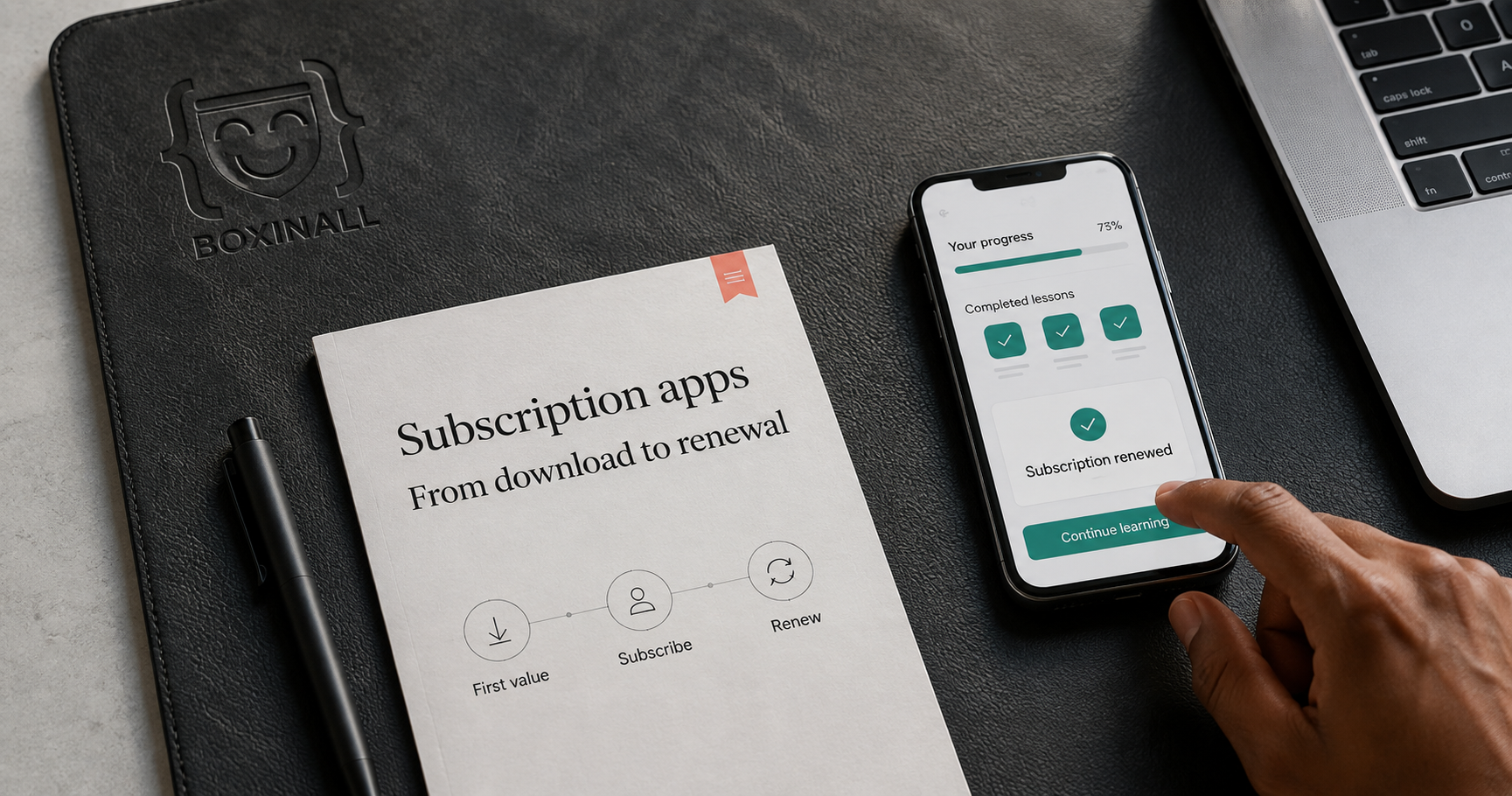
Subscription app development in 2026 means building the complete journey from initial interest to continuing value: discovery, onboarding, purchase, everyday use, billing and renewal. A polished interface attracts attention. A dependable product gives customers a reason to stay.
For founders, CTOs and product managers, this guide explains what to build, how the subscription system should work and which measurements reveal whether the business is progressing.
What Is Subscription App Development?
Subscription app development is the process of creating software that gives customers continuing access to features, content or services in exchange for recurring payments. It combines product design, mobile and backend engineering, purchase integration, access management and subscription analytics.
Think of a learning app that provides new lessons, practice sessions and progress tracking. Charging customers is one function. Delivering useful learning experiences every week is the product.
Before choosing a subscription model, answer this question:
What valuable thing will customers still need from this app next month?
Continuing utility can come from a maintained content library, saved work, collaboration, progress tracking or a service that supports a regular activity. It does not always require adding new features.
If the app solves a single, occasional problem, a one-time purchase or pay-per-use model may fit better. Apple also explicitly requires ongoing customer value for auto-renewable subscriptions. Apple App Review Guidelines
Why the First Customer Experience Matters in 2026
RevenueCat’s State of Subscription Apps 2026 analyzes more than 115,000 apps using its platform. Most performance metrics cover 2025. One finding is especially relevant: 55% of cancellations of three-day trials happen on the day the trial starts. That does not mean 55% of all trial users cancel immediately; it describes when cancellations occur within that trial group. RevenueCat’s report and methodology
These are observational benchmarks from RevenueCat’s dataset, not a forecast for every new app. For a product team, the practical implication is to test whether customers experience something worthwhile during their first session.
A longer feature list cannot compensate for a confusing beginning.
Map the Journey Before You Design the Screens
A useful subscription journey has six stages. Each stage should have a clear customer objective and a measurable result.
| Stage | Customer question | Product responsibility | Useful measurement |
|---|---|---|---|
| Discovery | Is this relevant to me? | Make an accurate, specific promise | Store listing conversion |
| Activation | Can this help me? | Deliver a meaningful first result | First-value completion rate |
| Subscription | Is this worth paying for? | Explain the offer and complete the purchase | Trial or purchase conversion |
| Continued use | Does this fit my routine? | Help customers repeat the useful activity | Repeat core-action rate |
| Renewal | Is the value continuing? | Sustain the experience and process billing correctly | First paid renewal rate |
| Recovery | Can I fix a problem or return later? | Support billing recovery and straightforward reactivation | Recovery and reactivation rates |
For the examples below, imagine a language-learning app offering short lessons and progress tracking. This is an illustrative product, not a Boxinall client case study.
1. Turn the Download Into a Meaningful First Result
Your app-store listing makes the first promise. Onboarding should fulfill it quickly.
If the listing promises short lessons for busy professionals, opening the app should lead toward a short lesson. A long questionnaire, premature notification requests and an unrelated dashboard introduce friction before the customer understands the value.
Ask only what improves the next step
Our learning app might initially need a language and an approximate skill level. A detailed profile can wait until it becomes useful.
Let customers explore before registration when the product permits it. When an account is necessary, explain its purpose, such as saving progress across devices.
Define activation as customer progress
Registration is an administrative event. Activation should represent a useful outcome.
- Learning app: complete a lesson and understand the feedback.
- Fitness app: find and complete a suitable session.
- Productivity app: organize a real task and retrieve it successfully.
- Media app: find relevant content and start watching or listening.
Measure how many new users reach that outcome, how long it takes and where others stop. Watch a few people attempt it before adding more onboarding screens.
The first result does not need to demonstrate every premium feature. It should give the customer a credible reason to continue.
2. Build an Offer People Can Understand
A paywall is the screen where users compare a subscription offer and decide whether to buy. Its job is to make that decision informed and straightforward.
Show the benefits included, the billing period, the amount charged and what happens after any introductory offer. Provide accessible subscription-management information, terms and privacy links.
For example, an annual plan described as “$5 per month” should also clearly state that $60 is charged annually. Those figures illustrate presentation only; they are not pricing recommendations.
Choose plans that match how customers use the product
| Model | When it can fit | Question to resolve before launch |
|---|---|---|
| Monthly subscription | Customers want flexibility and receive recurring value | Will the first month justify another payment? |
| Annual subscription | The benefit extends across a year | Is the total commitment clear and credible? |
| Freemium | A useful free tier can support discovery or ongoing adoption | Is the upgrade benefit understandable? |
| Free trial | Customers need hands-on experience before deciding | Can they experience the core benefit within the trial? |
| Subscription plus usage charges | Some activities create meaningful variable costs | Can customers predict and control their spending? |
Start with the fewest plans that represent a real customer choice. Additional tiers introduce more explanations, entitlements, upgrade paths and testing.
Test paywall timing against the journey
Some products can demonstrate value before purchase. Others need a preview or a clear explanation before providing paid access. Select timing that fits the product, then test it.
For the learning app, compare showing an offer after a sample lesson with showing it before access to the full course. Judge the result using paid conversion, refunds and subsequent retention together.
A higher trial-start rate is not enough if the additional users leave before paying.
3. Choose the Purchase Route Before Building Checkout
Payment architecture depends on what you sell, where the app is distributed and which markets you serve.
For digital content and functionality consumed in mobile apps, Apple and Google generally require their store purchase systems, with exceptions and alternative-payment programs that vary by storefront, product and eligibility. Physical goods and services follow different rules. Check the rules for the actual launch markets before selecting the checkout flow. Apple’s payment guidelines, Google Play’s payments guidance
Stripe or Razorpay may support an appropriate web subscription flow. Their availability does not, by itself, establish that the same checkout is permitted inside every mobile app.
For a global release, build a market checklist covering supported purchase methods, displayed currency, local pricing, translations and customer support. Avoid assuming that a US purchase flow transfers unchanged to India or the UAE.
Keep purchases and access separate
The payment system records a transaction. An entitlement represents the features or content a customer is allowed to use.
Monthly and annual purchases might both unlock the same “Premium Learning” entitlement. Keeping that access level separate from individual product identifiers helps the application handle multiple plans consistently. Subscription platforms such as RevenueCat support this approach. RevenueCat’s entitlement documentation
The engineering consequence is important: displaying a successful purchase screen should not be the sole authority for unlocking protected backend services. Google recommends verifying purchases on a secure backend before granting access. Google Play purchase security guidance
4. Build the Subscription Lifecycle, Including the Difficult Parts
Customers can purchase, renew, cancel, upgrade, lose payment authorization or restore a purchase on another device. The app must understand those changes.
Cancellation and expiry are different. Turning off renewal ordinarily leaves access available until the current entitlement ends; refunds or revocations can have different effects. Likewise, a failed payment does not always mean immediate loss of access.
Google Play distinguishes grace periods, when subscription benefits remain available, from account hold, when access should be suspended. Apple offers an optional Billing Grace Period that can preserve access during payment recovery. Google Play subscription lifecycle, Apple’s billing recovery guidance
Use verified provider status and effective dates to determine access. A single isSubscribed flag cannot describe the entire lifecycle reliably.
Make the edge cases part of the release criteria
Before launch, test whether:
- A completed purchase unlocks the correct benefits.
- An interrupted or pending purchase shows an accurate status.
- Reinstalling the app or changing devices restores the right account’s access.
- Renewal still updates access while the customer is not using the app.
- Repeated or delayed billing notifications do not corrupt access or duplicate rewards.
- Cancelling renewal displays the appropriate access end date.
- Upgrades, downgrades, refunds and expiry produce the intended result.
For developers, this requires authenticated event handling, duplicate-event protection and reconciliation with the purchase provider. In plain language, the system must safely recheck what happened when notifications are repeated, late or missed.
Support staff also need a safe way to inspect a customer’s purchase source and access status. Otherwise, a recoverable billing problem becomes an extended support conversation.
5. Give Customers a Reason to Return
The subscription offer creates an expectation. Everyday product use determines whether that expectation holds.
For the learning app, the second session should feel connected to the first: saved progress, an appropriate next lesson and feedback the user understands. Finding the next useful activity should require little effort.
Three design decisions deserve particular attention.
Make progress visible. Show completed lessons, finished tasks or another meaningful outcome. A streak can encourage participation, but it should not replace evidence of benefit.
Remove recurring friction. Slow startup, lost progress, broken media and confusing navigation affect returning customers repeatedly. These problems deserve attention alongside new features.
Use reminders with purpose. Let users choose relevant reminders and suitable times. A message tied to their chosen activity is more useful than a generic request to open the app.
Match retention measurements to the product’s natural rhythm. Daily activity may be meaningful for a language app. A monthly reporting tool can be valuable without daily use.
6. Prepare for the First Paid Renewal
Define the milestone carefully. A trial becoming a paid subscription is trial conversion. The first subsequent successful payment is the first paid renewal used in this guide.
For a monthly plan, that renewal comes at the end of the first paid month. For an annual plan, it arrives approximately a year later. A successful annual purchase therefore cannot establish annual renewal performance after a few weeks.
Before renewal, help customers see their progress, find the next useful activity and understand their subscription status. Where you provide reminders, use accurate dates and prices and align them with the provider’s notices and applicable requirements.
Treat product churn and billing churn differently
Voluntary churn happens when a customer chooses to leave. Investigate relevance, value, usability and price. An optional cancellation question can help, provided it does not obstruct cancellation.
Involuntary churn happens when continued payment fails. Help customers reach the correct billing-management screen and respect the provider’s recovery and access rules.
A discount does not repair lost progress. A new feature does not update an expired payment method. Diagnose the failure before choosing the response.
After renewal, continue delivering the service customers expected. An automatic charge is a billing event; continued use and feedback provide additional evidence of satisfaction.
What Should a Subscription App MVP Include?
A minimum viable product should test a focused customer benefit while supporting the subscription journey around it.
| Area | Essential initial capability |
|---|---|
| Core experience | One valuable activity that customers can complete repeatedly |
| Onboarding | A short route to first value and appropriate account creation |
| Offer | Clear benefits, localized prices and trial or plan terms |
| Purchase | Supported purchase flow, verification and error handling |
| Access | Correct entitlements, restoration and device/account mapping |
| Subscription management | Accurate status and access to cancellation or billing controls |
| Operations | Content administration, support tools and useful logs |
| Measurement | Activation, purchase, usage and billing events |
| Quality | Crash monitoring, accessible screens and lifecycle testing |
| Privacy | Necessary permissions, data controls and account-deletion handling |
Handle account deletion and subscription cancellation as related but distinct workflows. Explain the billing consequences and provide the appropriate controls; do not assume that deleting a profile automatically stops a store subscription.
Community feeds, referral schemes, gamification and extensive personalization can wait unless they are essential to the core benefit. A modest feature scope still requires dependable billing and access.
A Practical Technology Stack
The following is a reference architecture to evaluate, not a claim about a specific Boxinall project.
| Layer | Options to evaluate | Selection criterion |
|---|---|---|
| Mobile interface | Flutter or React Native; Swift/Kotlin for native development | Device needs, team experience and purchase SDK support |
| Backend | Node.js or Python with a relational database such as PostgreSQL | Account, access and business-logic requirements |
| Purchase integration | StoreKit and Google Play Billing, directly or through a subscription platform | Lifecycle coverage and operational responsibility |
| Website and admin | React/Next.js | Customer account, content and support workflows |
| Infrastructure | AWS services suited to the workload | Reliability, deployment and operating requirements |
| Analytics and monitoring | Product analytics, crash reporting and billing-event reporting | Ability to connect behaviour with verified outcomes |
For many focused apps, a shared mobile codebase and a managed subscription platform are worth evaluating. Native development may be preferable when device integration or platform-specific experience is central.
A managed billing service can reduce integration work, but the team still owns product configuration, account mapping, customer experience and testing. Verify SDK compatibility before committing to a framework.
Keep sensitive service credentials on the server. Use the same account and entitlement design across mobile and web so that a returning customer is recognized correctly.
Measure the Journey With Clearly Defined Numbers
Choose measurements before launch. Every rate needs a denominator, a time window and a customer group.
| Metric | Definition for your dashboard |
|---|---|
| Activation rate | New users completing the defined first-value action within a set window, divided by new users in that group |
| Trial-to-paid conversion | Trial starters reaching a successful first payment, divided by trial starters whose conversion window has ended |
| First paid renewal rate | Subscriptions completing their first paid renewal, divided by first-paid subscriptions whose first renewal and defined recovery window have elapsed |
| Repeat core-action rate | Activated users repeating the useful activity within a stated period, divided by activated users eligible for that observation |
| Billing recovery rate | Failed-renewal cases recovered within a stated window, divided by failed-renewal cases observed through that window |
| Refund rate | Refunded paid transactions divided by paid transactions in the same defined group and observation period |
For first renewal, include customers who turned off auto-renewal before the due date. Excluding them would hide customers the product lost. Separate monthly and annual plans, and do not include subscriptions that are too young to have reached the milestone.
An illustrative calculation
Suppose a monthly-plan cohort has completed every observation window below:
- 1,000 new users start using the app.
- 400 complete the first lesson within the activation window.
- 200 start a trial.
- 80 make a successful first payment.
- 48 complete the first paid renewal within the agreed recovery window.
That gives a 40% activation rate, 40% trial-to-paid conversion and 60% first paid renewal rate. These are fictional teaching figures, not targets or Boxinall results. The 80 initial payers remain the renewal denominator, including those who cancelled.
Now the team can investigate a particular stage instead of responding to a vague statement that “retention is weak.”
Check the business economics as well
Compare customer acquisition cost with the contribution customers generate after platform/payment fees, refunds and variable delivery costs. Keep taxes and gross-versus-net revenue treatment consistent.
Annual cash received upfront is not the same as monthly recurring revenue. For internal run-rate reporting, a $120 annual plan is commonly normalized to $10 per month before the relevant adjustments; formal revenue recognition is a separate accounting matter.
Avoid projecting lifetime value from a tiny or immature cohort. Observe actual payments, usage and costs before increasing acquisition spend substantially.
What Determines Development Cost and Timeline?
Two apps with the same subscription screen can require very different budgets.
| Scope decision | What it adds to the work |
|---|---|
| iOS, Android and web | More purchase routes, device checks and account synchronization |
| Video, audio or offline content | Delivery, storage, downloads and access controls |
| Multiple tiers and offers | More eligibility, upgrade and entitlement combinations |
| Existing subscriber migration | Identity matching and protection of existing access |
| CRM, ERP or third-party integrations | Data mapping and failure handling |
| Multiple languages and markets | Localized interfaces, pricing and purchase-flow validation |
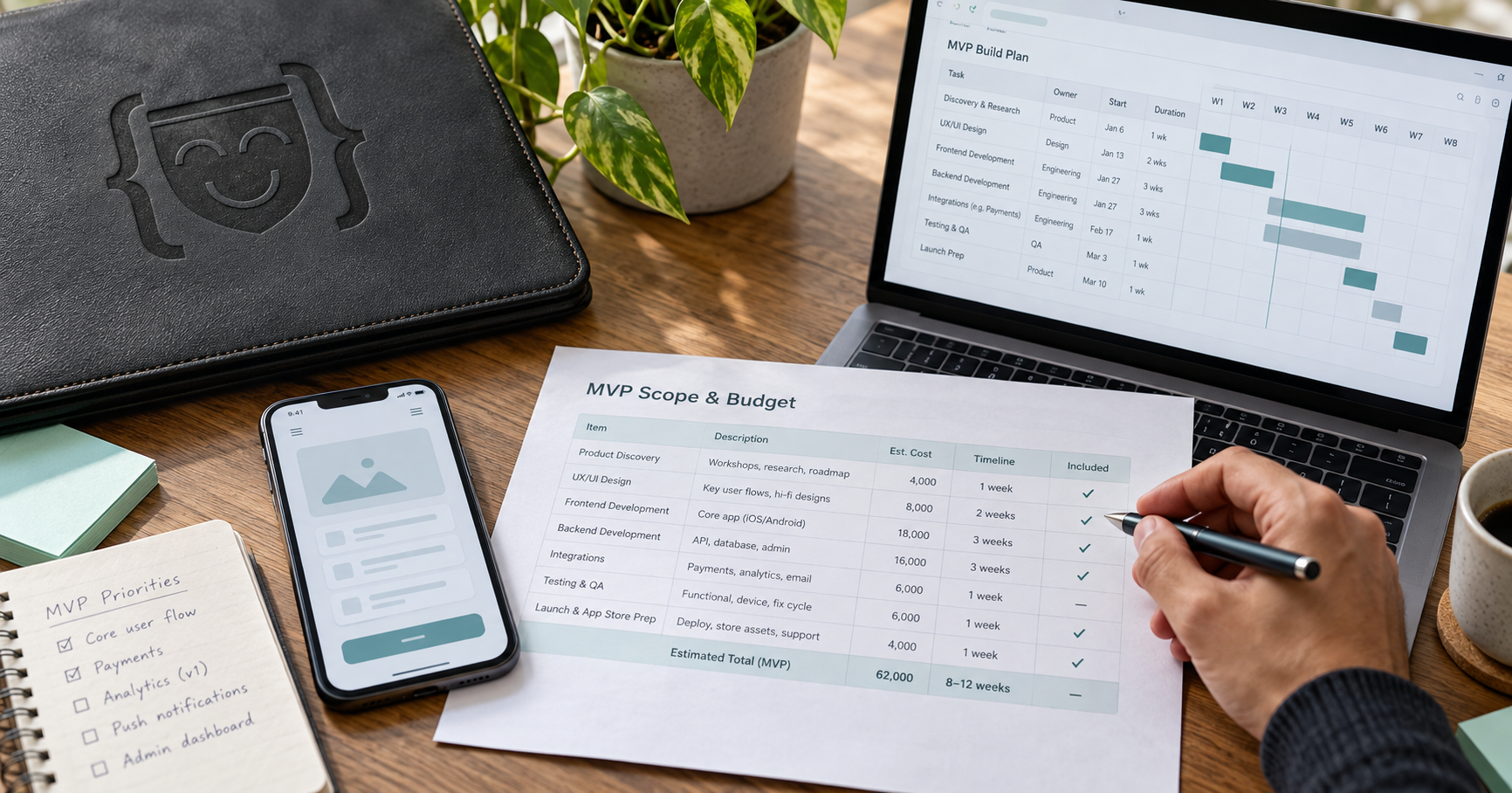
Ask for an estimate broken down into discovery, design, core product development, subscription integration, administration, testing and release support. Request the currency, scope assumptions and exclusions explicitly, whether your budget is in INR or USD.
Also budget for continuing content or service delivery, infrastructure, subscription tooling, support and monitoring. Ongoing customer value has an ongoing operating cost.
Scope should determine the estimate. A meaningful timeline also includes purchase testing and time for app review; review approval is not a date a development team can guarantee.
Turn the Idea Into a Clear Development Brief
Before commissioning the app, complete these seven statements:
- Our customer is: a specific audience with a recurring need.
- They return because: the app provides a defined continuing benefit.
- Their first useful result is: an observable activity or outcome.
- Our initial offer is: a clear plan, price and any trial conditions.
- Our launch scope is: named platforms, markets and essential features.
- We will measure: activation, paid conversion, first renewal and delivery cost.
- After launch, ownership sits with: named people responsible for content, product performance, billing and support.
Use that brief to prototype the first session, test the purchase lifecycle and release to a focused audience. Fix the largest measured obstacle before expanding the feature set or marketing budget.
This gives founders and development teams a shared definition of success that extends beyond submitting an app to the stores.
Frequently Asked Questions
How much does subscription app development cost?
The estimate depends on the core experience, supported platforms, content delivery, billing routes, integrations and testing scope. Request an itemized quote in your preferred currency. A paywall alone is not enough information to price the full application.
Should a subscription app offer a free trial?
A trial is useful when hands-on experience helps customers assess the benefit. Choose its length around the time needed to experience that benefit, then measure paid conversion and subsequent retention. A trial is not required for every subscription product.
Can I use Stripe or Razorpay in a subscription app?
It depends on the purchase type, storefront and applicable platform programs. These providers may support web or otherwise permitted transactions. Check the current rules linked in the purchase-route section before adding an alternative checkout to an iOS or Android app.
Should I build for iOS or Android first?
Start with evidence about your audience’s devices, intended markets and acquisition channels. A focused platform launch can simplify early learning. If both platforms are essential, evaluate a shared codebase while budgeting for separate store and device testing.
What is a good first renewal rate?
There is no useful universal target. Compare the same plan duration, product category and customer segment using a consistent definition and completed observation windows. Set an initial baseline, then test improvements against your own cohorts.
Does cancellation immediately remove premium access?
Turning off auto-renewal ordinarily preserves access until the existing entitlement ends. Refunds, revocations and other lifecycle events can behave differently. Base access on the purchase provider’s verified state and effective dates.
What should I prioritize after launch?
Check whether customers reach first value, whether purchases unlock access reliably and whether users repeat the core activity. Investigate the largest failure point, while monitoring billing recovery, refunds and support feedback.
Build a Subscription Customers Have a Reason to Keep
The first download gives your product an opportunity. The first payment creates a commitment to deliver. Renewal depends on how well the product supports that commitment over time.
Start with a recurring customer need. Make the first benefit easy to experience, the offer easy to understand and access reliable across the subscription lifecycle. Then use evidence from real customer groups to improve the journey.
Boxinall’s mobile, web and backend development services are relevant across these parts of the product. If you are planning a subscription app or improving an existing one, bring your audience, core use case, target platforms and monetization idea to the discussion.