Two founders ask for an MVP app. Both want login, a dashboard, notifications, and payments. One receives a quote for USD 22,000; the other receives a quote for USD 60,000.
At first glance, the lower number wins. Then the details emerge. One quote covers a single platform, a basic payment handoff, and a short warranty. The other includes product discovery, an administration interface, subscription-state handling, accessibility checks, automated tests, store submission, and support through the first release.
Neither price is automatically fair or unfair. They describe different products.
The question is not simply, “How much does an MVP app cost?” It is: What is the smallest dependable product that will test the business idea, what work is required to launch it, and what remains to be paid after launch?
This guide gives founders a transparent way to answer that question. It includes three sample budget bands, a worked estimate, the costs that often disappear from proposals, and a practical method for deciding which features belong in version one.
The Short Answer: An MVP Has No Universal Price
An MVP can be a focused single-workflow app, a connected product with payments and operations, or a two-sided service with several user roles. The budget changes with the work, not with the label “MVP.”
The following figures are illustrative scenarios, not Boxinall quotations or market benchmarks. To make the calculation inspectable, each uses a hypothetical blended delivery rate of USD 50 per hour and a separate 20% uncertainty reserve. Your actual rate, scope, team, region, and contract terms may differ substantially.
| Illustrative scope | Delivery effort | Modeled build at USD 50/hour | Build plus 20% reserve | Directional elapsed time |
|---|---|---|---|---|
| Focused MVP: one main journey, limited roles, simple backend | 400-700 hours | USD 20,000-35,000 | USD 24,000-42,000 | About 8-14 weeks |
| Connected MVP: stronger admin, integrations, analytics, and release controls | 700-1,200 hours | USD 35,000-60,000 | USD 42,000-72,000 | About 12-22 weeks |
| Complex MVP: two-sided workflows, sensitive data, or several consequential integrations | 1,200-2,000 hours | USD 60,000-100,000 | USD 72,000-120,000 | About 20-36 weeks |
These amounts exclude taxes, paid acquisition, third-party usage, app-store or payment charges, and post-launch operations unless a proposal explicitly includes them. The timelines assume a properly staffed team and timely decisions. More people do not always compress a dependency-heavy project.
Can a founder spend less? Yes, by narrowing the product, validating through a web experience first, using an existing platform, or building a prototype instead of a production-ready app. The mistake is calling an untested prototype a launch-ready MVP.
What Should the MVP Prove?
An MVP is a product built to test a specific business assumption with real users. It must deliver enough value to make the test meaningful and enough reliability to trust the result.
Start with one sentence:
“For [specific user], the app helps them complete [valuable task] so we can learn whether [business assumption] is true.”
For an exam-preparation app, the assumption might be that structured practice and feedback help learners return each week. For a vendor-commerce app, it might be that a shop owner can publish products and successfully receive an order without specialist help.
Those are different MVPs, even if both include accounts, screens, and notifications. Boxinall’s published MOPREP case study describes practice, timed tests, performance feedback, and offline synchronization. Its LoBecho case study describes vendor onboarding, a product catalog, payments, and order management. The case studies do not provide project budgets; they show why a feature list alone cannot explain cost.
The first release needs the smallest complete journey, not the shortest list of screens. A checkout that cannot reconcile an order is not a complete commerce journey. An offline practice screen that loses progress on reconnection is not a complete learning journey.
The Founder Test for Every Feature
Ask four questions before putting a feature into the first release:
- What business assumption does this feature help us test?
- Can the first user outcome happen without it?
- What failure would it prevent, and how costly would that failure be?
- What evidence would tell us to expand, change, or remove it later?
A feature can be essential because it creates value, protects trust, or is required for a compliant launch. A feature should not become essential merely because a competitor has it.
How an MVP Estimate Is Built
A useful estimate starts with a scoped workflow, not a number per screen. The same screen can be inexpensive when it displays static content and expensive when it coordinates identity, payments, inventory, location, permissions, and recovery from failed network calls.
Use this budget equation:
Delivery budget = estimated role-by-role hours x agreed blended or role rates
Launch envelope = delivery budget + uncertainty reserve + external one-off costs
First-90-day envelope = launch envelope + operating and support costs for 90 days
The reserve is not a hidden fee. It is a visible allowance for unresolved assumptions. A discovery phase should reduce it by replacing guesses with decisions. It should not be used to excuse an undefined scope.
A Worked Estimate: One Connected MVP
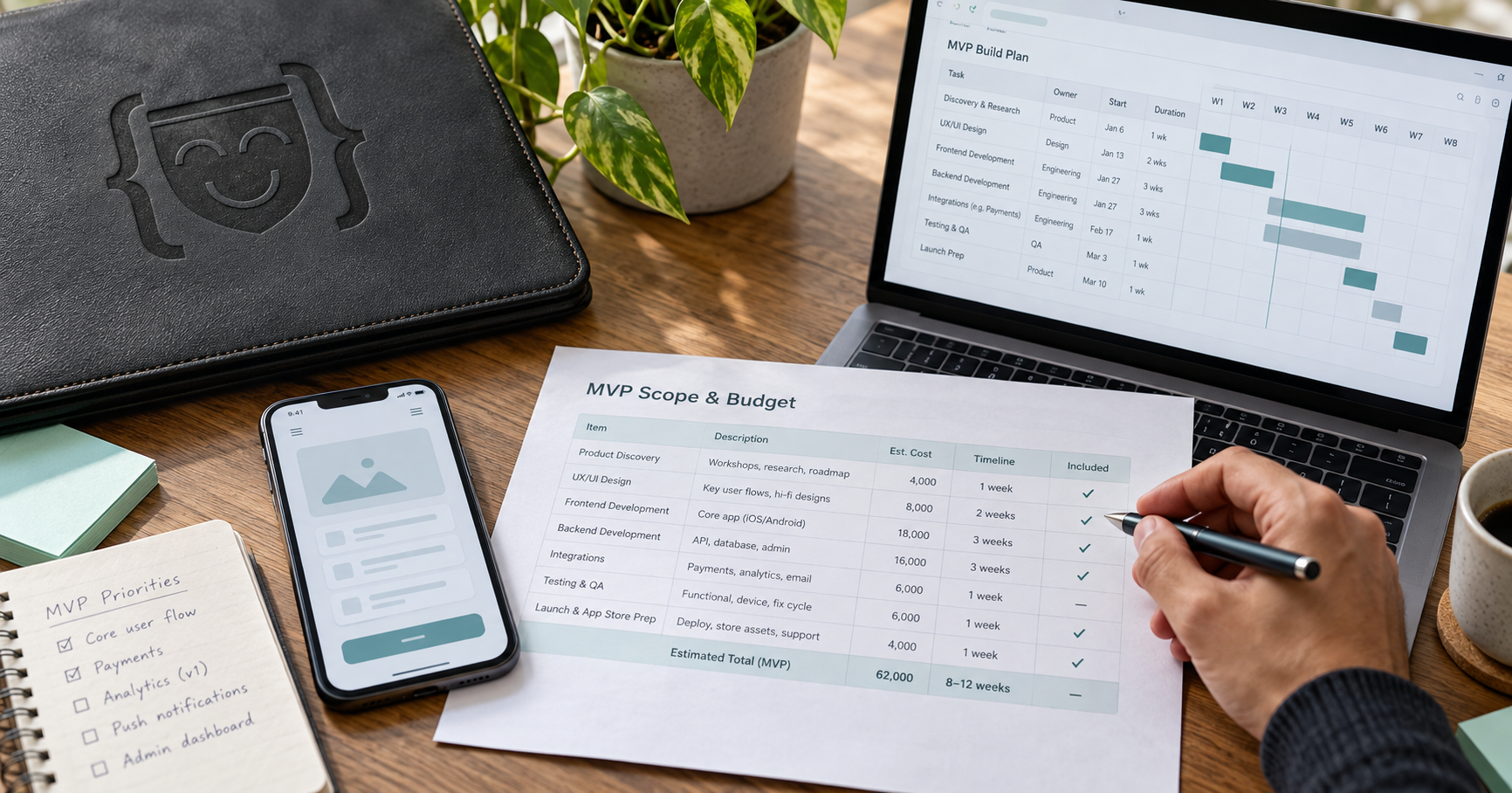
Imagine a single customer app with account access, one core service journey, a modest administration area, notifications, one third-party integration, analytics, and release to one app store. This is a teaching example, not a Boxinall project.
| Workstream | Illustrative hours | What the work includes |
|---|---|---|
| Discovery and specification | 70 | User journey, assumptions, scope, acceptance criteria |
| UX and interface design | 110 | Flows, accessible states, prototype, handoff |
| App client | 260 | Screens, state, navigation, offline/error states where needed |
| API and data | 220 | Auth, permissions, business rules, data model, admin functions |
| External integration | 90 | Provider setup, validation, failures, reconciliation |
| QA and test automation | 125 | Device, workflow, regression, security, and release checks |
| Store release and handover | 45 | Listing, submission, release configuration, documentation |
| Total | 920 |
At the hypothetical USD 50/hour rate, the modeled build is USD 46,000. A 20% reserve adds USD 9,200, producing a USD 55,200 launch envelope before external fees and post-launch operations.
The arithmetic is useful because a buyer can challenge it. If the app has no external integration, remove that workstream and revisit related testing. If it needs two platforms, multi-language support, and complex billing, add the actual effort. If a quote cannot explain the major workstreams, the total is not yet a reliable decision tool.
Price the Business Promise, Not the Screen Count
Here is a less obvious source of budget variance: the consequence of being wrong.
An incorrect product recommendation may cause a poor experience. An incorrect payment state may grant or deny access. A lost offline answer may destroy a student’s work. A leaked health record can have far more serious consequences. As the cost of a failure rises, design, permissions, testing, observability, and recovery must become more rigorous.
For each core workflow, estimate not only the happy path but also:
- Who is allowed to start, approve, and reverse it?
- What happens when a third-party service times out?
- Can a repeated request create duplicate records or charges?
- What does the user see when connectivity disappears?
- How will support staff understand and correct a failure?
That is where experienced product engineering shows up in a budget. It is not an optional polish line.
The Choices That Move the Price Most
1. Platform and delivery route
Native iOS and Android development can be the right choice when deep platform integration, hardware access, or specific performance requirements dominate. Cross-platform development can reduce duplicated client work when the two experiences are similar. It does not eliminate separate testing, store preparation, platform-specific behavior, or backend work.
Sometimes a responsive web product or PWA is the smarter first test. If the idea depends on acquisition through the app stores, native device capabilities, or offline field use, that shortcut may not test the real proposition. Decide from the user journey, not a technology slogan.
2. User roles and back-office operations
“One app” may include a customer experience, a vendor experience, and an administrator’s workspace. Each role needs different permissions, views, notifications, and support paths. If people must operate the product, budget for the tools they need rather than expecting them to edit database records manually.
3. Integrations and data quality
An integration is not just an API connection. It includes credentials, mapping, rate limits, error handling, retries, reconciliation, and ownership when data disagrees. A stable well-documented service is different from a legacy system with unclear records or manual exports.
Ask who owns the external system, what environments are available for testing, and what happens when the provider changes its API or pricing.
4. Security, privacy, accessibility, and compliance
The required depth depends on the product and jurisdiction. Account deletion, data collection, consent, access control, and auditability may affect architecture from day one. Apple requires developers to provide app-privacy information, including relevant third-party data practices, for App Store distribution; its App Privacy guidance describes those responsibilities.
Do not price a health, finance, children’s, or regulated workflow as a generic content app. Obtain jurisdiction-specific legal and compliance advice where needed; an engineering estimate is not a legal opinion.
5. Speed and uncertainty
Moving faster can cost more when parallel work, specialist availability, rapid decisions, or additional QA environments are required. Unclear requirements can also consume more time than a carefully scoped but technically harder feature.
The most useful way to reduce cost is often to reduce uncertainty before construction, not to cut testing after construction.
Hidden Costs Founders Should Put on One Page
Founders often compare a build quote with a launch budget. They are not the same thing.
| Cost line | Why it appears | Question for the proposal |
|---|---|---|
| Product discovery and research | Prevents building the wrong workflow | Which assumptions, interviews, or prototypes are included? |
| Content, catalog, and data preparation | The app needs trustworthy material to display or process | Who supplies, cleans, migrates, and maintains it? |
| Admin and support tools | Someone must operate exceptions and customer requests | Which staff tasks can be done without an engineer? |
| Device and accessibility testing | Users do not all use the same phone or interaction mode | What devices, states, and accessibility checks are covered? |
| Store accounts and release work | Submission requires accounts, listings, declarations, and review | Who owns the accounts and manages rejection or resubmission? |
| Payment and subscription operations | Billing needs verification, refunds, access, and recovery | Which stores, payment methods, and failure paths are included? |
| Cloud and third-party usage | Hosting, storage, messages, maps, search, and analytics can scale with use | What usage assumptions and price alerts are in place? |
| Monitoring and incident response | A release needs crash reports, logs, alerts, and an owner | Who responds when the core journey fails? |
| Maintenance and platform changes | Devices, OS versions, SDKs, and policies change | What is included after warranty, and at what rate? |
| Growth and user support | Building an app does not create distribution | Is acquisition or customer support in another budget? |
Store enrollment illustrates the difference between a small visible fee and a much larger operational task. Apple currently lists its Developer Program at USD 99 per membership year, with regional variation; Google Play lists a USD 25 one-time registration fee. The accounts are inexpensive relative to most builds, but preparing a compliant release still requires work. Check the current Apple enrollment terms and Google Play account guidance for the relevant region.
For apps selling digital features or subscriptions, store billing rules and fees can materially affect both architecture and unit economics. They vary by platform, program, product, and market. Decide the commercial model early and verify the current Apple in-app purchase guidance and Google Play payments policy rather than assuming a web-checkout design can simply be copied into the app.
Budget the First 90 Days After Release
Add a separate operating worksheet before approving the build:
Monthly operations = infrastructure + third-party usage + monitoring
                   + support and maintenance effort
First-90-day operating provision = monthly operations x 3
For a purely illustrative plan, USD 250/month in cloud resources, USD 100/month in messaging, USD 75/month in monitoring, and 15 support hours/month at the teaching rate of USD 50/hour produce USD 1,175/month, or USD 3,525 for the first 90 days. These are planning inputs, not vendor prices or a forecast for your app. Marketing, transaction fees, and taxes would still need their own lines.
The Boxinall Scope-to-Signal Ledger
Here is a planning method we recommend for founders commissioning an MVP. It converts each feature from a wish into a testable decision. It is a proposed worksheet, not a claim about a proprietary Boxinall product or an unseen client engagement.
| Feature or workflow | User outcome | Assumption tested | Failure risk | First-release decision | Evidence after launch |
|---|---|---|---|---|---|
| Sign-in | User returns to their work | Repeat use matters | Account and access errors | Include if continuity is essential | Successful return sessions |
| Core action | User completes the valuable task | The product solves a real problem | Broken primary promise | Include | Completion and repeat use |
| Payment | User pays for value | Willingness to pay | Incorrect charge or access | Include only if monetization is being tested now | Paid conversion and payment failures |
| Advanced personalization | Experience adapts to the user | Tailoring improves retention | Complexity without learning | Usually defer | Compare outcomes after a simple baseline |
| Admin exception view | Staff resolves stuck cases | Operations can support users | Unresolved failures | Include when the core flow has exceptions | Resolution time and unresolved cases |
The decision is not always “build” or “delete.” It can be simulate, handle manually, integrate, build, or defer. A concierge-style manual step may prove demand before a costly automation, provided the user experience remains honest and the process can safely handle the test volume.
The Reliability Floor
Founders often hear “MVP” and think “anything that works in a demo.” We recommend a different boundary: cut breadth before cutting the reliability of the core journey.
For a commerce concept like the vendor flow described in Boxinall’s LoBecho case study, a new product might defer sophisticated product categorization. It cannot meaningfully test order demand if payment status and order records regularly disagree. For a learning concept like MOPREP, a new product might defer social features, but it must preserve a learner’s completed work if offline use is part of the promise.
This is a product decision, not a universal feature prescription. The ledger makes the trade-off explicit.
How to Compare Two MVP Quotes Without Buying the Wrong Thing
Ask each vendor to fill the same one-page comparison. A total without matching assumptions is not a comparison.
| Compare | Quote A | Quote B |
|---|---|---|
| Platforms, user roles, and launch markets | ||
| Named core journeys and acceptance criteria | ||
| Discovery and UX deliverables | ||
| Backend, admin, and integrations | ||
| Testing, security, and accessibility scope | ||
| Store submission and release support | ||
| Explicit exclusions and client responsibilities | ||
| Third-party subscriptions and usage assumptions | ||
| Change-request pricing and contingency | ||
| Code, design, data, accounts, and IP ownership | ||
| Warranty, maintenance, and incident response |
Then ask for a change-order stress test: “What happens to the price and timeline if the payment provider changes halfway through? If a new user role is added? If the first store submission is rejected?”
A credible delivery partner will state what can be absorbed, what must be re-estimated, and which decision belongs to the founder. An impossibly precise price for an undefined product is not certainty. It is an unexamined assumption.
A Timeline That Includes Decisions, Not Just Coding
A modest MVP may move through these stages, with overlap where appropriate:
- Discovery and scope: Define the target user, core journey, success signal, constraints, and known integrations.
- Prototype and technical validation: Test the difficult interaction and the riskiest external dependency before building everything around them.
- Incremental delivery: Build the core journey with reviewable working increments, not a single reveal at the end.
- Release readiness: Test failure states, permissions, accessibility, analytics, store requirements, and operational handover.
- Limited launch: Observe real use, support issues, conversion, and repeat behavior before expanding scope.
The founder’s decisions are on the critical path. Delayed feedback on a prototype, unavailable API access, changing pricing rules, or an undecided content owner can extend the schedule even when engineering hours stay constant.
Decide in advance who can approve scope, who supplies content and third-party accounts, and what constitutes acceptance of the release. A timeline without decision owners is optimistic fiction.
What Should Success Look Like After Launch?
An MVP does not have to become profitable in its first month. It does have to produce evidence worth the money spent.
Choose one primary outcome before development starts: a completed booking, a first paid order, a finished learning session, an accepted service request, or another concrete user result. Add a small set of supporting measures such as activation, repeat use, failed attempts, time to complete, support demand, and customer feedback.
Set a decision date and criteria. For example: “After 30 days of invited users, we will expand if enough target users complete the core action, return for a second use, and can explain the value without help.” The exact thresholds must come from the market and business model; this article cannot invent them for your company.
Do not confuse downloads with validated demand. Do not confuse an analytics event with a paying customer. And do not expand the feature list to disguise a weak core proposition.
What to Ask Boxinall Before Requesting an Estimate
Boxinall’s mobile app development work spans native, cross-platform, backend, and launch delivery. To get a useful scope discussion, bring five things:
- The target user and the one job the app must help them finish.
- The platform and market where that user will first encounter it.
- The systems, payments, content, or data the app must connect to.
- The constraint you cannot compromise: budget ceiling, deadline, security requirement, or operational need.
- The evidence that would justify funding a second release.
Ask for at least two scope options: a smaller validation release and a fuller first product. Both should show assumptions, exclusions, timeline dependencies, ownership, release responsibilities, and post-launch costs.
Bring the idea and the constraint. Contact Boxinall to turn them into a scope that can be priced, challenged, and built.
Frequently Asked Questions
Can an MVP app cost less than the sample budgets above?
Yes. A prototype, a simple web-first test, a narrower single-platform release, or a product built on an existing service may require fewer hours. Make sure the lower price still covers the outcome you intend to validate. Do not compare a clickable prototype with a secure, published app as if they are the same deliverable.
Is cross-platform development always cheaper than two native apps?
No. It can reduce duplicated client implementation when behavior is similar, but platform-specific features, testing, store work, and backend systems remain. The right choice depends on the workflow, devices, performance requirements, and maintainability.
Should an MVP include payments?
Only when payment is necessary to test the business model or deliver the first complete journey. If it is included, budget for failures, refunds or cancellations as relevant, access/entitlement rules, reporting, and applicable store policy. A payment button alone is not a billing system.
What is the most commonly omitted cost?
There is no single universal answer, but founders often underestimate the work around the app: data preparation, administration, QA, release compliance, support, monitoring, and ongoing third-party usage. Compare full launch and first-90-day envelopes, not only coding hours.
How long should an MVP take?
The sample scopes in this guide span roughly 8 to 36 elapsed weeks because they represent very different products. A valid estimate needs a defined journey, dependency list, team plan, and decision schedule. Fixed-date promises made before those inputs are known deserve scrutiny.
Does adding AI make an MVP faster or cheaper?
It may accelerate selected drafting or development tasks. It can also add model usage, evaluation, data, privacy, support, and failure-handling work. Include AI only when it improves the user outcome being tested, and measure its total operating cost rather than the cost of a single model call.
Who should own the app and its accounts?
Put code, design files, domains, app-store accounts, cloud accounts, analytics, data, documentation, and handover rights in the agreement. The founder should understand which assets remain accessible if the delivery relationship ends. Exact ownership terms belong in the contract, not in a verbal assurance.
Final Takeaway
The cheapest quote is not the cheapest path if it omits the core journey, creates avoidable rework, or leaves the product impossible to operate. The most expensive quote is not automatically more complete.
An MVP budget becomes credible when a founder can see what will be learned, what will be delivered, what can fail, what is excluded, and what it will cost to keep the product running after release.
Build the smallest product that can produce trustworthy evidence. Price the entire first journey. Then let real user behavior, not a long wishlist, decide what comes next.