The restaurant industry is rapidly evolving, and digital transformation is no longer optional. Whether you run a fine-dining restaurant, cloud kitchen, or multi-chain brand, investing in a restaurant mobile app can dramatically improve customer engagement, streamline operations, and boost revenue.
But one of the most common questions business owners ask is:
“How long does restaurant app development take?”
In this detailed guide by Boxinall, we break down timelines, influencing factors, development phases, and strategies to speed up the process without compromising quality.
Average Timeline for Restaurant App Development
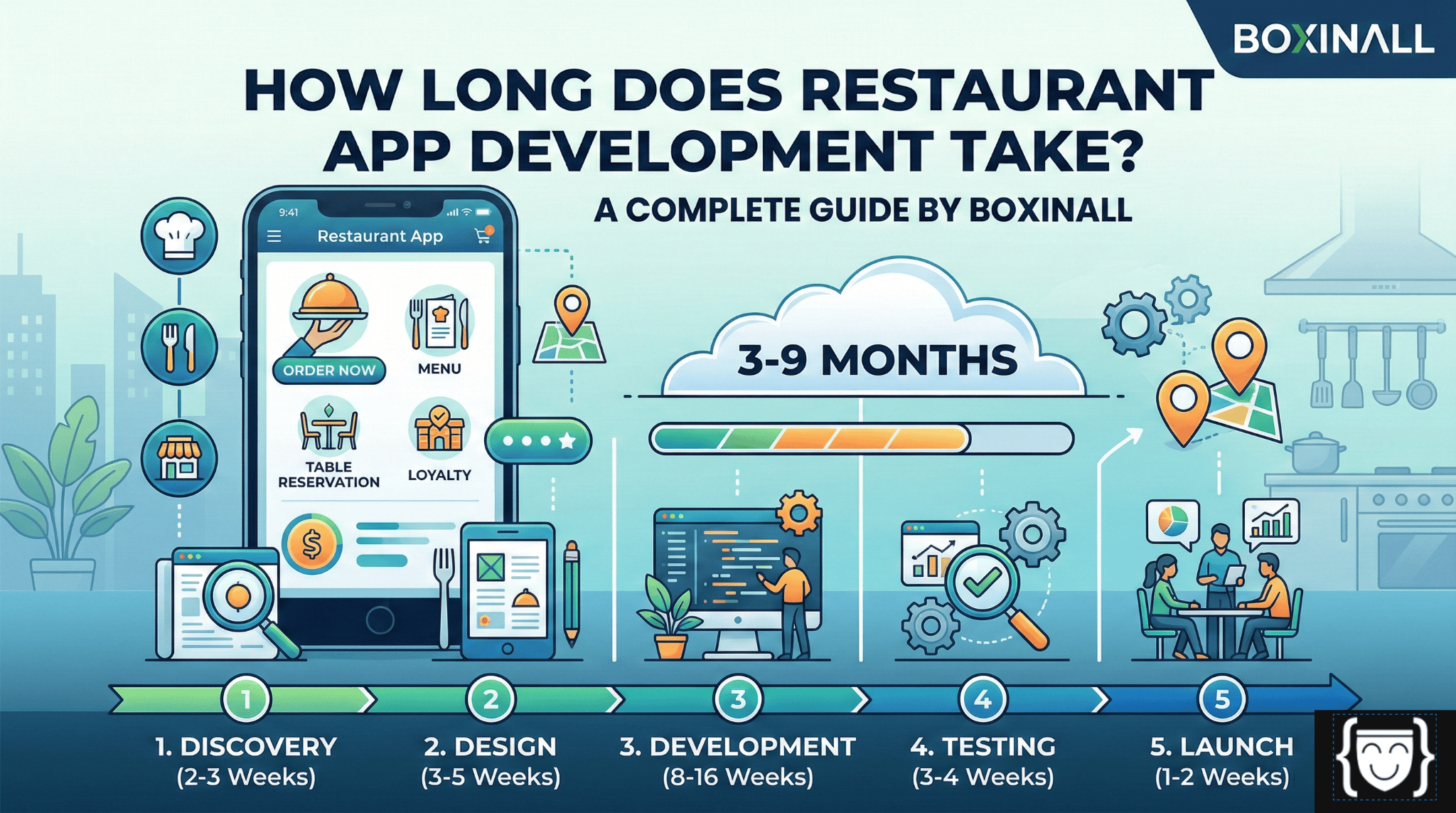
Restaurant app development typically takes 3 to 9 months, depending on complexity, customization, and scalability goals.
Here’s a general breakdown:
| App Type | Estimated Timeline |
|---|---|
| Basic Ordering App | 3–4 Months |
| Custom Restaurant App with Booking | 4–6 Months |
| Multi-Location or Chain App | 6–9 Months |
| AI-Integrated Smart Restaurant App | 7–9+ Months |
The timeline largely depends on feature scope, integrations, design complexity, and backend architecture.
Key Factors That Impact Restaurant App Development Timeline
1. Feature Scope & Functionality
The more advanced the features, the longer the development cycle.
Basic Features:
- Menu display
- Online ordering
- Secure payment gateway
- Order tracking
- Push notifications
Advanced Features:
- Table reservation system
- Loyalty programs
- AI-based recommendations
- Real-time delivery tracking
- POS system integration
- Multi-location management
Clearly defining your feature list at the beginning prevents scope creep and project delays.
2. UI/UX Design Complexity
A highly customized, interactive, and brand-focused UI requires:
- User journey mapping
- Wireframing
- Prototyping
- Design testing
Clean, intuitive, and mobile-first design improves customer retention — but detailed UI work adds time to the development cycle.
3. Technology Stack & Platform Choice
Your choice between:
- Native (iOS & Android separately)
- Cross-platform (Flutter, React Native)
- Web-based solutions
directly affects development speed.
Cross-platform development often reduces time-to-market, while native apps provide deeper performance optimization and customization.
4. Third-Party Integrations
Integrations significantly impact timelines, especially if you connect with:
- Payment gateways
- Delivery partners
- CRM systems
- Inventory management tools
- POS systems
- Cloud kitchens
- Marketing automation tools
Complex API integrations require testing and validation, which adds development time.
5. Scalability Requirements
If your app is built for:
- Multi-city expansion
- High-traffic usage
- Franchise operations
- Multi-vendor marketplace model
The backend architecture must be robust and scalable from day one — increasing planning and development duration.
Step-by-Step Restaurant App Development Process
Understanding the roadmap helps you estimate timelines more accurately.
1. Discovery & Requirement Analysis (2–3 Weeks)
- Market research
- Competitor analysis
- Feature planning
- Monetization strategy
- Technical feasibility review
2. Wireframing & UI/UX Design (3–5 Weeks)
- User flow mapping
- Prototype creation
- UI design
- Client approvals
3. App Development (8–16 Weeks)
- Frontend development
- Backend development
- Database setup
- API integration
4. Testing & Quality Assurance (3–4 Weeks)
- Functional testing
- Security testing
- Performance optimization
- Bug fixing
5. Deployment & Launch (1–2 Weeks)
- App Store submission
- Play Store submission
- Server deployment
- Post-launch monitoring
How to Reduce Restaurant App Development Time
If you want faster market readiness, consider these strategies:
1. Start with an MVP (Minimum Viable Product)
Launch with essential features first:
- Menu
- Ordering
- Payments
- Notifications
Add advanced features later in Phase 2.
This reduces initial development time by 30–40%.
2. Use Agile Development Methodology
Agile planning allows:
- Iterative releases
- Faster feedback loops
- Continuous improvements
- Reduced rework
It keeps development flexible without compromising quality.
3. Define a Clear Monetization Strategy
Before development begins, decide whether your app will generate revenue through:
- Commission model
- Subscription model
- Delivery fees
- Advertising
- Loyalty memberships
Clear monetization planning avoids mid-project changes.
Cost vs Timeline Correlation
Generally:
- Shorter timelines require larger development teams.
- More features increase both cost and duration.
- High customization increases design and backend time.
A well-planned roadmap ensures accurate time and budget estimation.
Why Choose Boxinall for Restaurant App Development?
At Boxinall, we accelerate restaurant app development through:
- Structured discovery workshops
- Experienced mobile app developers
- Optimized workflows
- Scalable backend architecture
- Agile sprint-based execution
- Continuous testing approach
Our team focuses on building stable, high-performance restaurant apps that are scalable, secure, and future-ready.
Final Thoughts
Restaurant app development is not just about building an ordering system — it’s about creating a complete digital experience for customers.
The timeline depends on:
- Feature scope
- UI complexity
- Technology stack
- Integrations
- Scalability requirements
- Testing strategy
With proper planning, MVP prioritization, and expert development support, your restaurant app can be launched within 3–6 months and scaled over time.
If you’re planning to develop a restaurant app, Boxinall can help you build a reliable, scalable, and revenue-driven solution tailored to your business goals.